

Scope
Flooring, wall cladding, countertops, and façade dry-hang projects
Goals
Stable quality, controlled color/size tolerances, fewer reworks and claims
1,Standards & Baseline
- Reference: EN/ASTM/KSA (e.g., EN 12372 flexural, ASTM C97 absorption, ASTM C170 compressive, ASTM C241 abrasion)
- Typical tolerances (vary by country standard and project; customizable):
- Thickness: ±0.5–2.0 mm (interior fit-out often ±1 mm; façade/large slabs may be wider)
- Length/Width: ±0.5–2.0 mm (precision tiling ±0.5–1 mm; landscape/thick slabs wider)
- Warpage: ≤0.5–2.0 mm per 1000 mm (façade panels typically tighter than flooring)
- Chamfer/edge: consistency per drawings and approved master sample
- Color variation: visual grading or ΔE threshold (e.g., ΔE ≤ 2–5), same-box same-area matching
- Approve and label a master sample; use as visual and performance benchmark
- Test frequency: per batch sampling (1–2 pcs/type); third-party witness for critical projects
2,Simple Workflow
- Incoming & Supplier
Check blocks: structural cracks, color banding consistency, resin/fill marks, mesh/pinholes
Record batch, quarry/origin, ID; photos and raw dimensions
Supplier rating: approved list; return/claim history - Process QC
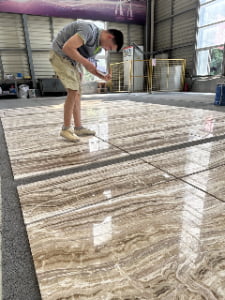
Calibration & cutting: first-article thickness/size/diagonal check with records
Finishes: gloss units (GU), flamed/bush-hammered/matt uniformity vs. sample
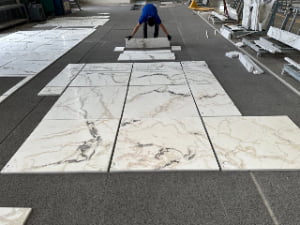
Layout & color: same-area same-box color matching; plan vein/book-match with photo approval
Wet areas slip resistance: confirm per EN/ASTM (e.g., DIN 51130 R-rating or ASTM E303) - Final Inspection
Verify dimensions, flatness, edges, hole positions, chamfer; keep records
100% check for critical items (countertops/corners/fascia); others per AQL (e.g., General II, 2.5)
Non-conformities: quarantine, recheck, disposition; over-tolerance release requires client’s written approval - Packing & Shipping
Moisture/impact-proof crates, ISPM 15/IPPC mark; separators/protection film; corner protectors
Box list and barcode; two-way link between photos and layout map (crate code ↔ layout)
Include CO/CI/PL, QC report, install & maintenance guide, origin & test certificates 
3,Key Checks
- Thickness/size consistency; diagonal tolerance
Color difference and vein continuity (use ΔE or visual grading if needed)
Surface defects: pits, scratches, resin repairs, chipping
Gloss level or slip resistance (required for wet areas)
Dry-hang hardware reliability (e.g., pull-out/shear tests)
4,Common Issues & Actions
- Cracks: scrap structural cracks; repair surface cracks with client’s written approval and labeling
Color shift: re-layout by zones for visual consistency; add photos/color cards if needed
Warpage/thickness variance: re-calibrate
Edge chipping: enhance packing and corner protection; rework/replace chipped pieces
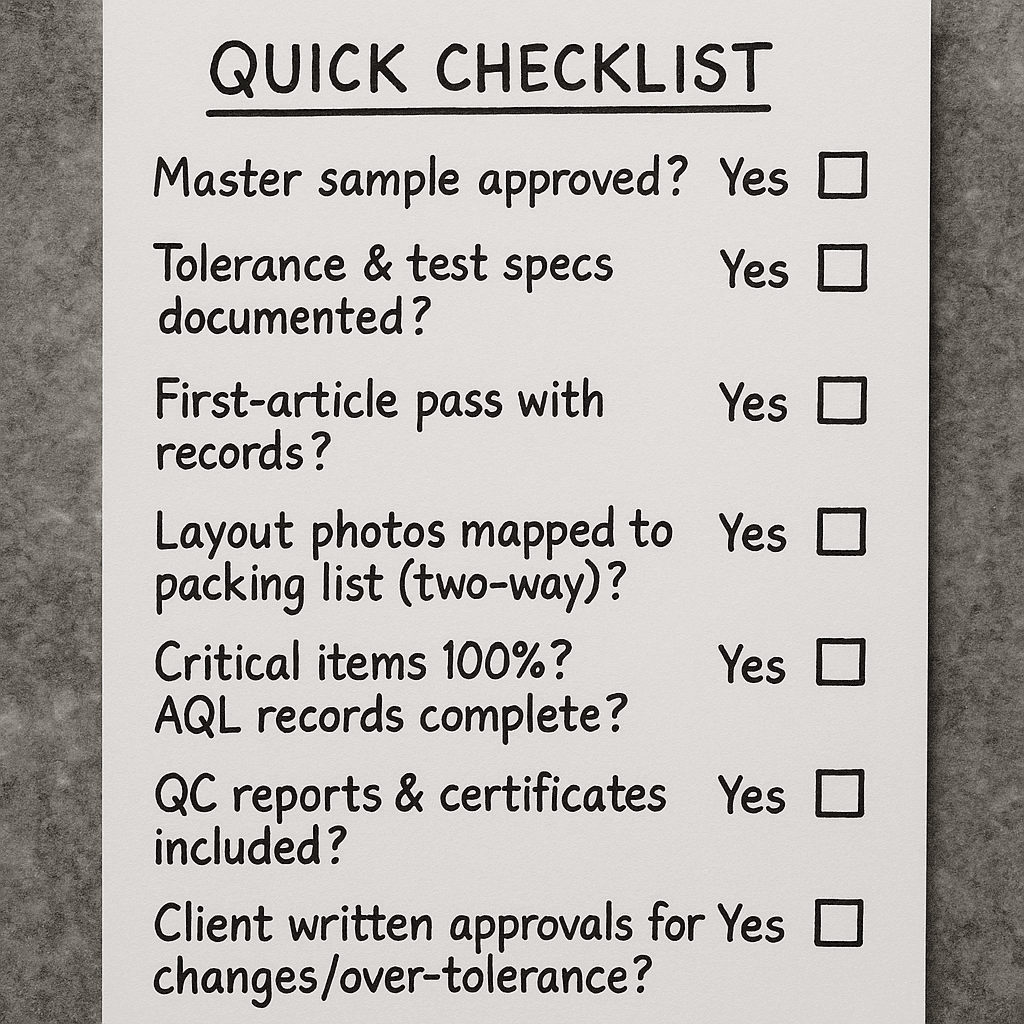
5 ,Quick Checklist
6,Communication & Tracking
- Confirm milestones: sample, layout, pre-assembly or pre-shipment inspection
Close the loop: find—correct—recheck—record—archive
Visual tracking: batch ledger; crate code ↔ layout online lookup; photos with consistent lighting/angles